Why I Invented the Now-Next-Later Roadmap

The Now-Next-Later roadmap exists because timeline roadmaps aren’t effective, simple as that. Timeline roadmaps insist on deadlines, which means product teams are deprived of the flexibility that allows them to do their best work.
I invented the Now-Next-Later roadmap because I believe that, rather than focusing on deadline-based delivery, product teams should stay focused on discovery.
A Now-Next-Later (NNL) roadmap is a product roadmap framework that organizes initiatives into three horizons rather than fixed delivery dates—Now, Next, and Later. This helps teams communicate priorities and strategic direction without creating false certainty.
Product discovery means staying aware of customer needs and business opportunities, and ensuring that the company is building the right thing according to recent data. Not churning out-of-date stuff from last year’s to-do list.
There’s plenty to say about why timeline roadmaps are awful and how your team can ditch the timeline roadmap – in fact, I’ve created a whole course on that very subject, helping teams transition away from timelines. 👇
Learn how to replace rigid timeline roadmaps with the Now-Next-Later framework and align your team around outcomes instead of deadlines.
But this post is all about the Now-Next-Later format, how to use it, and why it’s the better choice.
Let’s dive in!
What is a Now-Next-Later roadmap?
The Now-Next-Later roadmap is a product management tool that organizes work into three time horizons, from immediate to long-term, starting with the most urgent problems to solve. This roadmap format conveys the overall product vision, as each element of work is tied back to a business objective.
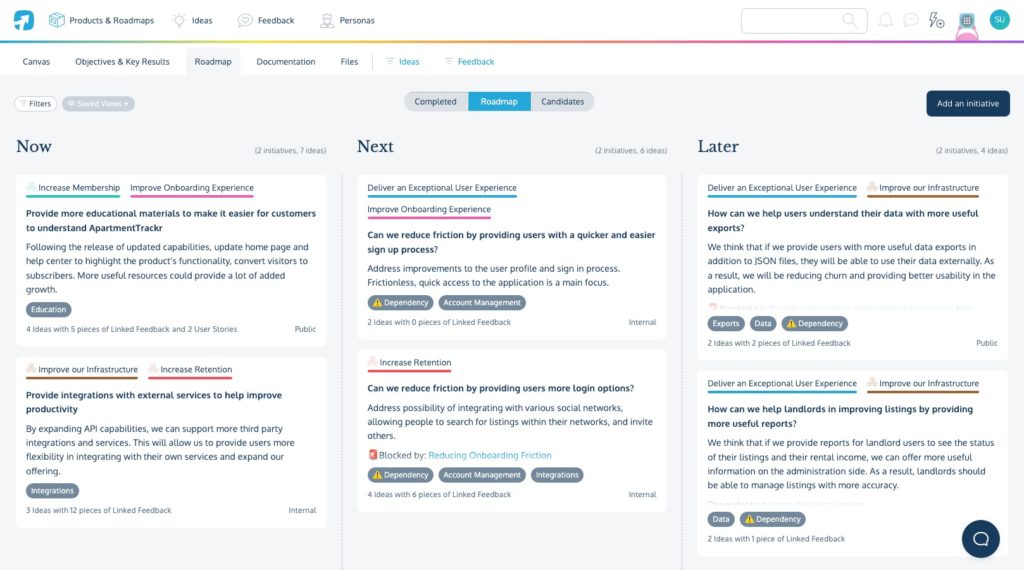
The first Now-Next-Later roadmap
The first version of this roadmap was a reaction to a mess.
At my previous companies, we ran product planning out of Jira and a release planner. Both were built for engineers, so they were long, detailed, and almost impossible for anyone outside the team to read. The backlog kept growing, the dates kept slipping, and every roadmap conversation turned into a negotiation about deadlines instead of a discussion about what actually mattered.
I needed something a stakeholder could understand in about ten seconds. Something that showed what we were working on, what was coming up next, and what we were still thinking about, without pretending I knew the exact week any of it would ship.
So I dropped the dates and drew three columns: Now, Next, and Later. The Now column held the work we were confident about and actively building. Next held the problems we expected to pick up once the current work wrapped. Later held the bigger, fuzzier problems we wanted to keep in view but weren’t ready to commit to.
That was it. No Gantt chart, no false precision, no buffer time baked into invented deadlines. Just priorities and direction, laid out so the whole company could read them. The first time I put it in front of stakeholders, the conversation changed. We stopped arguing about dates and started talking about which problems were worth solving first.
Why use a Now-Next-Later roadmap?
Now-Next-Later roadmaps are lean by nature, so they are a great fit for product teams that work in a lean way. The format keeps you moving forward without wasting precious resources.
Here are five more reasons why you should use a Now-Next-Later (NNL) roadmap:
- More human and flexible
- Allows for different levels of certainty
- Saves time
- Ties back to objectives
- Informs more impactful product decisions
1. More human and flexible
The fundamental thing about the NNL is that it removes the constraints of the timeline and gives you something much more human: time horizons. Time horizons are powerful because they allow you to move forward with a broad plan, yet only make commitments to what lies directly ahead of you.
You can’t make decisions far off in the distance or future, because you can’t see it clearly yet. And because you’re not making hard and fast decisions about the future, it remains flexible to your needs when you get there.
2. Allows different levels of certainty
No one is 100% sure all the time. NNL allows varying levels of certainty, and product teams can differentiate and prioritize their work based on that. The Now column is definite, while the Later column is full of possibilities.
In a way, certainty is portioned out over time horizons – which gives you the chance to become more certain, rather than commit too early.
3. Saves time
The NNL roadmap saves time because you don’t waste hours planning stuff into the future that you ultimately might not (or should not) build. It doesn’t make sense to go into detail about big, far-off ideas – just like it doesn’t make sense to assign them deadlines.
With the NNL, instead of plotting out a tedious delivery schedule, you spend your time researching, building, and fine-tuning the product work of the present moment.
4. Tied back to objectives
The NNL roadmap forces you to stay in touch with your business objectives and build with them in mind. Is the company prioritizing user growth or revenue? Trying to get market share or brand exposure? The product initiatives you prioritize will change depending on these objectives, and ultimately, your roadmap will reflect both your company and product strategy.
5. More impactful product decisions
Because you don’t get distracted or lost in details, and you spend time more wisely on things that are clearly tied to business objectives, you make more impactful product decisions with a Now-Next-Later roadmap. The format helps you focus on the goal, so the team makes choices that push the product forward.
What belongs in the Now, Next, and Later columns?
The Now, Next, and Later columns each contain product initiatives or ideas. But these initiatives and ideas vary in their level of certainty, scope, and how fully they’ve been spec’d. The columns don’t need to be equal in size, and they definitely are not set in stone.
Now
The Now column contains the initiatives that you are working on, well, now. These items are clearly defined, much more detailed, and completely spec’d out. They are clear and defined initiatives and ideas that are broken down into more granular pieces of work – because they’re in front of you and you can actually start on them right away.
You’ve got more confidence and clarity around what this work requires and what it will impact – as you should! Because this is the stuff happening at this very moment.
Next
The Next column is what will happen once everything in the Now column is complete. These are broken down less finely, with fewer specifics and details.
They’re not right in front of you yet, so you don’t need to spend much time fully figuring them out – they might be reliant on the success or failure of an initiative or idea in the Now column. But you understand that, at this moment, they’re next on the list.
Later
The Later column is everything else you’ve proposed doing, but it won’t happen until sometime in the undefined future. These items are hazy; they’re big boulder blocks that you can see in the distance but don’t need to break down yet. You know the general problems you want to solve but don’t have details about exact solutions yet.
The Later column keeps these problems on your radar – this is so important for ensuring your product vision stays consistent – as long as you know where you’re going you don’t have to know how you’ll get there. And, as Later columns move closer, you will continue to explore and spec them out in a more concrete way.
How to use a Now-Next-Later roadmap?
Using a Now-Next-Later roadmap is very simple once you know how, and there are three steps you need to follow to do it correctly:
- Prioritize at the problem level
- Define product initiatives
- Tie them back to business objectives
1. Prioritize at the problem level
You should prioritize problems, not ideas. This ensures you are building useful solutions into your product, rather than loads of nice-to-have features. Once you’ve identified the problems you need to solve, you can log them in the ProdPad roadmap. To each problem, you attach all of the different ideas, potential features, and experiments you could run in order to find a solution for it.
2. Define your product initiatives
Product initiatives are the tasks you’re working on to actualize any solutions and reach any goals. “Initiatives” are the prototypes, the experiments or tests, and the final solution you’re pushing to development.
You need to define these initiatives in the NNL roadmap, and then sort them based on urgency and certainty. If an initiative is time-sensitive and does need a certain deadline, you can communicate that within the product roadmap.
3. Tie them back to business objectives
You should be able to glance at the roadmap and understand what high-level success looks like for the business. Each product initiative must connect to a business objective, and this needs to be clear.
Best practice top tip: make it visual and obvious on your roadmap. In ProdPad tag each objective and relevant ideas with colorful labels and – boom – the business objective is clear. The colors delineate the “why” behind each product idea.
Want to build your own Now-Next-Later roadmap?
How to talk about your roadmap to stakeholders?
Talking about your product roadmap to stakeholders can be tricky or even daunting, especially if you (and everyone else) are new to working without deadlines in a Now-Next-Later format. The truth is that most of the company is experiment-driven, and the product team should be no different!
Because this entails a whole shift in mentality, you will likely need to change the product management vocabulary you use when you speak to stakeholders. You’ll need to educate those reluctant stakeholders and outline exactly why the Now-Next-Later will help you move faster, deliver more and drive better results. To help you get everyone on board, we’ve created a ready-made slide deck that you can download and present to those tricky stakeholders, taking them through an air-tight case for making the move to Now-Next-Later. You can download that presentation deck here. We’ve also put together some tips on how to communicate the roadmap status to your team, as well as five ways to communicate new product features to business-facing teams.
What methodology works best with a Now-Next-Later roadmap?
The Now-Next-Later roadmap is lean at its core, so it works with almost any methodology out there, including lean methodology or agile. It’s designed to be flexible, so you aren’t putting a fixed scope and a fixed deadline on work that you have already promised to stakeholders. Elements can be removed or reordered without disrupting the cadence.
Even if a team works in Kanban, Scrum, or a classic waterfall style, the NNL roadmap still allows you to prioritize in this flexible, problem-oriented way.
What pitfalls can you avoid with a Now-Next-Later roadmap?
There are many pitfalls you can avoid with a Now-Next-Later roadmap, but here are three of the most important ones.
- Endlessly shifting deadlines
- Low team morale
- Becoming a feature factory
1. Endlessly shifting deadlines
Deadlines are the root cause of so much product management pain. They create a vicious cycle of the timeline roadmap. Customers and management are confused or disappointed. Work estimates are artificially extended, the timelines are bloated, and the team moves slower. And yet still deadlines will be pushed!
Ultimately, due dates are a distraction. They make everyone feel very busy and important, but they are an illusion. And sometimes, they actually make people feel bad. On that note…
2. Low team morale
Missed deadlines and constantly reorganized workloads take a toll on morale. The team is doing its best, but they feel lousy – and they suspect the rest of the company (or customer base) perceives them as incompetent. Simply because the work is not suited to hard deadlines in the first place!
Not to mention the blame culture that can arise from a vicious cycle of shifting deadlines. No one wants to work in a place like that. Read on about how our pal Liz Love saved her team by switching to a horizon roadmap like NNL.
3. Becoming a feature factory
If you are hitting those deadlines and you are totally driven by output, guess what? You’re likely a feature factory. Sometimes referred to as the “build trap,” this mode of product development is dangerous because teams lose touch with the market and lose sight of the overall strategy. More features do not equal more success. Learn more about how to avoid becoming a feature factory but still achieve product differentiation.
What changed for teams that made the switch
I’ve watched a lot of teams move off timelines now, and the before-and-after tends to look the same.
Early adopters often came to it for transparency. Chef adopted ProdPad with one goal: a clearer view of which ideas were being prioritized for the roadmap, and why. The part that stuck wasn’t the product team’s view, it was what it did for everyone else. Their field teams in sales and customer success finally had a fuller picture of everything under consideration.
Chef adopted ProdPad in late 2016 with the goal to improve transparency into what ideas to prioritize for the roadmap and why. Our field teams, like sales and customer success, tell us they greatly appreciate having a fuller understanding of everything under consideration.
Julian Dunn, Senior Product Manager, Chef
The clearest before-and-after is the disappearance of two problems most product teams know too well: the roadmap “black hole,” and the out-of-date roadmaps circulating around the business. Julie Edwards, Head of Product Management at Rosslyn Analytics, watched both of them go.
The quantity of ideas being submitted has increased and the roadmap “black hole” and “out of date roadmaps in circulation” problem is no more.
Julie Edwards, Head of Product Management, Rosslyn Analytics
For some teams the shift is less about tidiness and more about the kind of conversation the roadmap makes possible. One Lead Product Manager described it as the only approach that kept the strategic conversation open, pulling focus away from committing to feature delivery and toward the problems worth solving and the experiments most likely to get there.
And once the roadmap is tied to objectives, it holds the team to something real. Keji Adedeji, Head of Product at Talis, found that linking objectives and key results to the initiatives on the roadmap kept the team focused and honest.
The ability to link our objectives and key results to the initiatives we are working on keeps us focused and honest as a team.
Keji Adedeji, Head of Product, Talis
Outcomes over output: Why OKRs and Now-Next-Later roadmaps are best friends
Objectives and Key Results (OKRs) are meant to be guideposts and benchmarks for the company at large, so you know where you are aiming and how well you are getting there.
There is actually a third component, initiatives, which I’ve mentioned throughout this post and which I liken to a forgotten middle child in the OKR discussion. Initiatives are the actions you are actually taking to achieve results and hit goals. Initiatives are the game plan. These are items you’ve spelled out on the Now/Next/Later roadmap.
This is why OKRs and NNL are BFFs. Your business objectives are baked into the product roadmap, so your team works toward outcomes – not just output. Learn more about Outcomes vs outputs.
To learn more, read on about how OKRs and lean roadmaps work together, how to write good Objectives and Key Results, as well as some pitfalls to avoid when implementing OKRs.
Lastly, if you want to try Now-Next-Later for yourself, you can – for free – in our interactive sandbox. To help you learn the ropes you can also find a dynamic product roadmap template, which you can use and edit in real time to create an effective Now-Next-Later roadmap for your product. Try our template out today and fall in love with Now-Next-Later.
More than a decade on: what I’ve learned
We sketched the first Now-Next-Later style roadmap . Since then it’s spread further than I ever expected, into teams and companies I’ll never meet. A few things have held true the whole way through.
The format was always the easy part. The hard part was helping people get comfortable trading dates for horizons. Leaders want certainty, and a horizon can feel like less of it, right up until they realize a date they were going to miss was never certainty in the first place.
The teams that get the most out of it define what Now, Next, and Later actually mean for them. A horizon with no shared definition just becomes a vaguer timeline. Spell it out: what has to be true for something to sit in Now, what earns a spot in Next, what keeps something parked in Later.
The roadmap shows the plan. The OKRs carry the commitment. When people worry that dropping dates means dropping accountability, that’s the answer. The commitment lives in your objectives and key results, measured and owned, which frees the roadmap to stay flexible. That flexibility is the whole point of it.
What makes it work is the conversation it forces into the open. The best moments I’ve seen are teams pulling up the roadmap in the middle of a meeting and rearranging it together, as a living record of what they’ve just decided. The columns are scaffolding for that conversation.
It’s also held up better than I expected against things I didn’t see coming. With AI in the mix and shipping velocity climbing, dated roadmaps fail even harder than they used to, because the timeline is obsolete within weeks. Horizons absorb that. The faster things move, the more a confidence-based view earns its place.
I built it because I needed a roadmap I could stand behind. More than a decade later, that’s still the whole test. If you can put your roadmap in front of anyone in the business and defend every choice on it without reaching for a date you’ll have to walk back, you’re doing it right.
Hi Janna,
Very insightful article, thank you. Just one question: the first mention I could find about the now/next/later framework dates back to 2012, on Thoughtworks blog (https://www.thoughtworks.com/en-de/insights/blog/now-next-and-later). Are you in any way related to that?
Thanks for the clarification
Haha, so cool! No, I hadn’t seen that article before today, so not related at all. As I mention in https://www.prodpad.com/blog/the-birth-of-the-modern-roadmap/, the original version that Simon and I sketched out in 2012 was titled Current/Near Term/Future, but functioned as the modern Now-Next-Later roadmap. We built it with renameable headers, and it was actually an early customer who dropped in the terms Now-Next-Later into the time-horizon roadmap we’d made, and we ended up changing the defaults for all.
Firstly, I really like this approach for all the reasons you mentioned. Also, agree that roadmaps as an organizational tool are challenging and ineffective. However, one thing I see missing in this approach is the future state vision and a coherent story of the execution that gets there. It seems there’s still a solution story underneath the Next / Later planning – maybe this needs to be called out separately?